Tuesday, October 2, 2012

Why Spanking Is Harmful

It seems that a week can't go by where there isn't some thread on a public page on Facebook where people are voraciously arguing over Corporal Punishment.  From what I have gathered those for it are in the minority. You might not know it, based on their reactions, but I always find that to be a good indication of how valid one really think their opinion is. If I know my actions are noble I won't feel the need to get over the top defensive if someone doesn't agree with me. I don't need them to tell me I am right, or agree with me to feel validated. If I feel confident in my own decision, then I will be able to have a civil debate about why I think the way I do and be okay if I can't sway the other party to my 'side' as it were.

So, what does science say about spanking? One recent study showed a clear association with

 "the proportion of illnesses such as depression, anxiety, alcohol and drug abuse as well as personality disorders that may be attributable to physical punishment".

 Another states
" Despite American Academy of Pediatrics recommendations to the contrary, most parents in the United States approve of and have used CP as a form of child discipline. The current findings suggest that even minor forms of CP, such as spanking, increase risk for increased child aggressive behavior. Importantly, these findings cannot be attributed to possible confounding effects of a host of other maternal parenting risk factors."

Those are just a couple of the studies that have shown that spanking isn't beneficial to any child for any reason, for any age. I can't find one study that says it is. If you have one, please share it with me. The interesting thing to me is, even though it is not recommended by any expert that knows anything about child development, the studies say parents continue to do it anyway.  This leads me to believe that we don't have enough information and know how to discipline differently. As humans we do what we know, even if it's not effective. We're creatures of habit and tradition.


My other issue with hitting kids (and make no mistake anytime you spank your child it IS by definition hitting them) is that it's illegal to hit anyone else, so why are children not afforded the same right?  If your spouse, neighbor, or waiter pisses you off you aren't allowed to hit them. Even if they lie to you, steal your stuff, or otherwise do something off the wall morally wrong. You are not allowed by law to hit them unless it's to defend yourself from harm. If you do, you can be arrested for assault. So, why is it okay to hit a little defenseless person?  What if you do it just enough to hurt them, and teach that neighbor of yours you mean business? Is that legal? No. So why is it legal to do it to a child. Hitting is hitting.

Before, all of you think that I am on my high horse, I will admit to using spanking a handful of times with my 2 oldest. I stopped, because it seemed not only ineffective, but it seemed to make their behavior worse. I set out to find another way. 
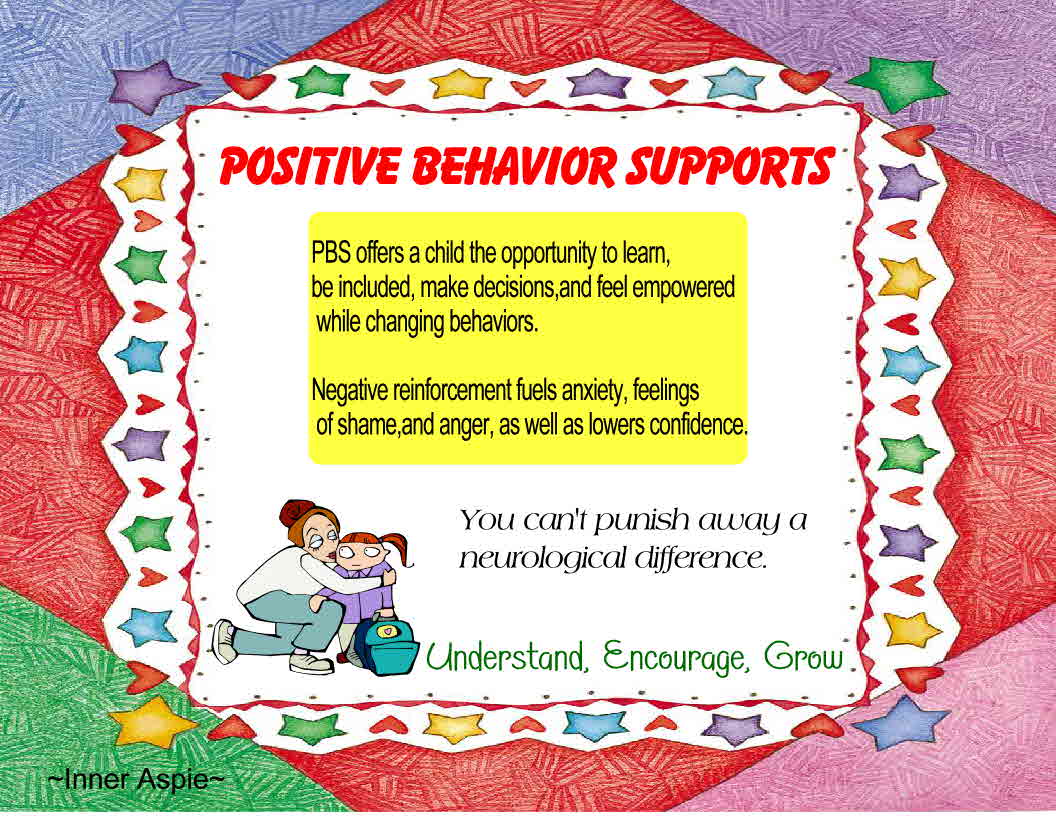
Different things work for different kids. All kids respond to some form of positive behavior reinforcement . Maybe, some need more redirection, frequent rewards and support than others, but they all respond to it.  No matter how stubborn, ornery, or different you think your child is, I guarantee you they will respond to some sort of positive behavior plan.  Everyone does. When we don't go to work our boss doesn't come over to our house and hit us. We simply pay the natural consequences of that decision.  I try to mirror that as much as I can with my kids. I try to relate any punishment or reward to the actual behavior itself.  If they don't do their chores, they won't get their stars on their chart, and they won't have money. The same with if we don't earn income. I don't buy them a lot of stuff. If they want toys and games, they have to earn it themselves. They don't throw fits at the store, because unless it's a special occasion they aren't expecting a toy. When I say no, I mean no. Every time, always. You throw a fit about my answer, you lose privileges. Consistently. I don't yell.  I don't threaten. I state my expectation and they know I mean what I am saying, because I am consistent in following through.  A lot of the time I see kids having bad behavior, because the parents reinforce it. Do you go back on previous no's, because you don't want to hear the whining? Do you let your child behave badly until you finally explode and yell, instead of getting the situation taken care of immediately?  Are you inconsistent on rules? Letting them sometimes do things that are against the rules, because it's easier for you in that moment, than to exert the energy to correct them?  When they fail to do something in real life, say at school, do you rush to bail them out, or do you let them handle the consequences of their own behaviors?

Conversely, when your children do something right, do you tell them? Eg; "great job making your bed, getting a good grade, helping a friend.."
Do you always stand up for them when it's warranted showing them that you have their back? Eg; The school is treating your special needs child in a way that is unfair, so you put your own feelings of shyness, busyness, ect... aside and take care of the matter.
Do you allow them times and space to be them, instead of micromanaging their time and activities?  Eg; allowing them time to watch tv and be on the computer without huge time constraints,  ect...
Do you allow them the individual freedom to choose, even if it's you don't agree with their decision (age appropriately, of course)? Eg; Allowing them to choose their own fashion, sports, friends, ect..

These are all examples of fostering a child's well being in a sense that allows them to feel good about themselves, and the world around them. When a child feels safe, secure and grounded they have the better tools to choose their behavior, rather than going on a series of impulsive reactions.

So, what is your preferred method of discipline? (Please note that I won't delete any comments, but I also won't respond to nasty ones, either)

And above all, please remember:

Punish the behavior, not the child!

Sunday, September 30, 2012

Do I Know You? ~This Aspie's Experience with Face Blindness.

I can feel him casually glancing in my direction. I make a point to look away and not  make eye contact, because I don't feel like having polite conversation at the pool with strange men I don't know.  Eventually, we cross paths and he asks me how I am. I can tell by his demeanor that he's not a stranger. He is someone I've met before and should be acquainted with. I search the pool to see if I recognize his children. I'm looking for any clues that can help me here, but none come. I just make small talk and try to figure it out later. It turns out to be one of my daughter's friend's parents. I've spoken to him in the last couple of weeks. I should know who he is.

The above scenario is probably something that has happened to most people before at some point, but for me (and many others on the spectrum) it happens often. There is a phenomenon called face blindness or Prosopagnosia.  I am unsure if I fit the criteria for this diagnosis. I took the face blindness test of famous faces and scored 93%. That is above average. I have no trouble identifying faces of famous people, even those I have not seen in 20 some years. My memory is quite good in that way. However, when social interaction in everyday life is introduced to the scenario I seem to lose the ability to identify acquaintances.

As you can imagine, this is troublesome. If I run into someone, say at the store it is very likely that I will not recognize them. I live in a small town, so it is certain to happen often, just based on the statistics alone.  So, maybe you are one of the son's paras, the secretary at the school, or the bank teller, the principal that I've sat through 10+ IEP meetings with, or my neighbors.... I will walk past you as if I've never met you, unless you make the first move.  I'm certain that this doesn't help my social life, as I know that I come off as snobby. It has to be terribly confusing to others, especially the ones that I warmly chat with on a regular basis to suddenly find me oblivious to them in another environment.

I wonder if Beans has this issue, too. He always smells people upon greeting them.He reaches out and grabs your clothes, and hair and sniffs.  I think he may be trying to identify who you are by your scent.

If you took the test, feel free to leave your score in the comment section, as well as any experience you may have with this issue, either with yourself, or your ASD loved one.

Wednesday, September 26, 2012

My Idea Of Being Spontaneous!

The other day I was shopping in Dollar General, waiting for a prescription to be filled. I had time to kill, so I wasn't running through the store doing my shopping in the usual beat the clock fashion. I typically dislike shopping and see it as a chore to get done and over with as soon as I can.  I happened into the Halloween aisle. I am one of the people that is always practical.  I don't see the point in spending money on things that aren't functional.  I am boring. My husband is the one who buys the holiday decorations and is often the one who puts them up. Most that I have come from relatives, no doubt looking to spruce my boring bare walled decor up!  

I didn't notice at the store that it's eyes are all wonky. Fits our home perfectly!
Anyway, I thought that maybe, it was time for me to be a little bit spontaneous. It was time for me to spend a few dollars on something that really has no practical purpose.  I bought a Halloween decoration for our yard.  Just a little something that symbolizes me doing something a little different, trying new things and breaking from the routine, even just a little bit.

Tuesday, September 25, 2012

Discussing staring, and #autism in public- join the conversation!

I shared the above image on my FB Page and Marilyn G. commented:
"Wanting to share and needing input. My autistic son was always a quiet one, so I never had to experience some of the feeling that you have. Many times I have been out in places and there has been a child being "loud". My immediate response is of concern and my reaction is to look at the child and the situation to evaluate in lightening (super mother power) speed if everything is ok with the child (I have seen a child being verbally abused in a Target to the point of tears before). I have never judged that child nor their parents during the "loud" period. But now because of so many posting saying things like glances or judgements of strangers, I feel that I can't look over to see if that child is ok, because I am afraid of offending the mother or father just for looking their way. My heart is going out to the child and even the parent in that moment, yet I feel that I will be misinterpreted and actually cause that mother or father more discomfort than if I had just not turned to see if all was ok. Is it possible that this is a real thing that occurs and some are to quick to judge? How can I feel comfortable caring?? I want to feel my heart go out, but I am concerned that just my glance would cause pain for mom or dad....where only understanding and connection is happening....not even a word spoken...not even one bad thought ever."

This was a very good question.  It forces the people that have special needs kids to answer some difficult questions about why we're offended, what if a child is in danger (meaning not ASD, but rather something is wrong) can we look to evaluate the situation, so that we ca intervene if needed?  How do others know when it is okay to look, or when it's hurtful?

I saw a program the other day called Head Games on the discovery channel about staring.  They basically set up an experiment in an auto shop waiting area where there was about 4 or 5 actors sitting around. In would come the clueless person that had no idea that the experiment was happening. They all acted friendly at first, but then gradually they all started staring at him. First, subtly, then not so subtly, then pretty much blatantly in his face stare downs by every person in the room.  In every situation the subject got up and left.  The psychologist explained that in a situation where someone is being stared at in public it automatically switches on the fight or flight area of our brains. (Most of our brains, that is... ) Humans are social creatures, so when people stare they are identifying you as not one of them. You don't belong in their group and you are not welcome. This makes the primitive part of our brain react . We get nervous, and have to figure out in a pretty quick hurry, are we going to defend our territory, or are we going to run away? This is pretty hard wired into neurotypical brains. It all occurs on a level that you're not even aware of when it is happening.  I was happy to see this episode, because my brain does not react this way. I rarely see people staring, because I rarely look at other people, and when I do I don't look at their faces.  Unless, it is balntant staring with an obvious expression of negativity I will not notice, nor will I care.  This explains to me why NTs act the way they do, and now I can understand their POV better, I can back off the judgments about them being dramatic about stupid things that don't matter. Now I understand, they can't help it.  It's how they're hardwired, the same as I can't help the fact that I don't look at all that social information that is happening around me.

Now, we understand why people get so upset when others stare at their special needs child, what can be done? Can we change the way we react to stares? Can we choose to respond differently, even with our brains sending us into fight or flight mode? Yes. I think we can. I think a little bit of knowledge can go a long way.

First, I want to point out that the majority of the people that I actually catch staring are doing so, because they know about autism and want to approach me and my family.  They want to say something, but don't know how to approach us.They want us to know they are one of us and belong to the autism community, or they saw my van sticker and want to know where they can get one.  They are analyzing and seeing if it's okay. I have that happen every so often and I do the same when I see a child/person with autism.

Sometimes, they don't know much about autism, but know that my Beans is obviously not a typical child and they want to acknowledge him. They want to include him and say hi to him, just like they do anyone else.  It's their way of non-verbally acknowledging to him and us, "I see you.I acknowledge your presence. I accept you here as you are in this public space and I support you, but I can't just say that, because that would be odd." So, they stare, often times until they feel comfortable enough to say something.

Then, you have the people that don't know about autism and don't know what to think of Bean's noises and movements. They stare wide eyed and oblivious to the fact that we can see them staring. I think this is the most common. People will look at things that are different. It's in our nature to identify differences and try to figure the situation out. I find it illogical to go out into public and expect people to NOT stare. In my life, that is just pretty much setting yourself up to be disappointed and upset, as well as making a big deal out of every public venture with your ASD child. It does not help their self esteem for you to do this, believe me, I know.  Learn to let go and be okay with others looking and your kids will, too.

Of course, you do run into the people that really believe that people like Beans should not be out in public, being noisy and messing up their idea of a perfect world. Unless they are directly interacting with you, I say ignore them.  Let their discomfort about their own personal hang ups be their own.  They have to live in their narrow world, but you don't.

So, how do you feel about staring? What would help you to be more comfortable with others that are just looking out of curiosity? What advice would you give strangers that just want to support you and give you encouragement in public on how to go about that?

Tuesday, September 18, 2012

Disobedience or Ethical Nonconformist?

I'm sure that many of you are aware of the Milgram Experiment where the subjects of an experiment thought that they were shocking someone in another room on the orders of a scientist, sometimes up to lethal levels. There was no real harm (no shocks were administered) involved, but the subjects didn't know that. The experiment was to see how regular people behave in the face of what they perceive to be authority.  The experiment was repeated recently in this program that I watched on the Discovery Channel How Evil Are You .  The subjects fared even worse in the realm of empathy for the person "being shocked" than they did years ago in Milgram's experiment.  They went further, questioned the scientist less, and only one (that I recall) stuck with their own ethics and what they knew to be the right thing to do.  All the rest said they didn't want to keep shocking the other person, but did so unless a peer was introduced at the same time to back them up. Almost none wanted to go against the grain and be a nonconformist.

I saw this type of thing play out on my own life about 2 or 3 years ago.  Every seven years or so we have to take the boys to get re-eveluated to keep their developmental disability services.  The state requires us to take them to a psychologist so that they can be tested for IQ and well as ASD.  Of course, they still have autism every time, so I find it to be ridiculous, but....not what this post is about!  We made an appointment with one of the approved psychs listed.

When we got there it was one of those older style Victorian houses that was turned into an office.  First visual clue to me that this might not be as professional of an operation as an actual office building.  We get paperwork started. As we sit in the waiting area a very old man peeks out and tells the couple sitting near us that he's done.  They go in and carry out what I assume is their daughter.  She has some kind of muscle disease and appears unable to really move her body willfully, or speak. Second red flag.  Why did he need to be alone with a child that cannot speak or communicate?  They had the same papers as we did, so they were there for the same reasons we were.  I doubt he had some kind of communication system set up with her and there was no keyboard or PECs or anything to suggest otherwise that I saw.This is was likely the first time he's met her.  The whole situation didn't make sense and my aspie brain does not like nonsensical things.When I encounter nonsensical things in my everyday environment it causes my brain to freeze and inquire as to why. Things that don't fit together have a reason, even if it's a small detail. My brain detects this and sees this as important. I'm am not a see the forest for the trees thinker.

He asks for me to come in without Bubby to asnwer some questions.  When I say that this man is old, I mean he is (and the secretary mentioned his age, so this is verified) in his eighties.  I was looking around to see if he still owned a copy of The Empty Fortress!  That was I'm sure the standard for autism when he was in school.  He asked me a few questions, and said he thought it was Asperger's.  I told him he had not even met my son yet. How can he know? Every answer I gave that pointed otherwise he would try to get me to change it back to verify his already made hypothesis!  I tried to politely explain that Bubby has a speech delay that is still present and should exclude him from an Asperger diagnosis.  He then asked for Bubby to come in. Hubby followed him in and sat down. The doctor asked us to leave so that he could be alone to ask Bubby questions.  My husband immediately hopped up to leave.  I did not.  I politely told him that I would rather stay in the room.  He told me I could not. My husband left in a nervous hurry at the doctor's very irritable insistence that we leave. I repeated myself.   He then exclaimed "What do you think is going to happen?" very loudly and angrily.  I repeated myself again.  I was not moving.  He went on to ask Bubby questions that were way above his level of language to answer.  He was also reading off of a sheet that he printed from a well known AS website. Not a real clinical checklist.  Nope. It was as if he read Bubby's file and decided it was to be AS before we even got there. 

When we left the office, my husband immediately said to me, "What did he do to make you distrust him so much? It must have been bad!"  My first response to this was to think, wow, so you know that this person did something seriously over the line, yet you were going to leave your child with him anyway?  He said he knew he shouldn't.  He said he knew if I said it was dangerous then it was a bad idea, but he said he didn't feel as if he had a choice.  He didn't know you could just refuse to do what the doctor said, despite his own judgment about the situation. He simply said that he was unable to explain why he did what he did despite the his ability to know it was not a good choice, even at the time.

I watch a lot of these sorts of social experiment shows. I like to people watch. I always find it fascinating that people do what they do in the name of social conformity.  Not that it is always a bad thing.  We would not be a society like we are if people didn't.  There are good and bad sides of conformity.  The same with being a nonconformist.  Us nonconformists question when others wouldn't.  We ask why.  You know how every kid goes through the why stage? I went through it something fierce.  My mother, who likes to pretend she has the patience of a saint said, and I quote "Your why stage was so bad that it would make anyone want to jump out of a moving vehicle to get away from the questions."  I never stopped, really.  I still question what doesn't make sense to me, and I will likely never stop!